

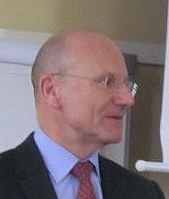
George Bright
Short bio by Susanna Wright
George Bright is a British Analytical Psychologist with more than three decades of private practice in West London. He is a Training and Supervising Analyst with the Society of Analytical Psychology where he teaches and supervises, and is also a Member of the Chicago Society of Jungian analysts.
Bright is particularly known for his teaching of Carl Gustav Jung’s The Red Book: Liber Novus currently in London, Chicago and Los Angeles. In 2016, he co-founded The Circle of Analytical Psychology, an educational group dedicated to a two-year close study of Jung’s Red Book and more recently, the Black Books. He argues that these texts are central to understanding the development of Jung’s mature psychology and clinical method.
As a writer, Bright has published influential papers in the Journal of Analytical Psychology, including ‘Synchronicity as a basis of analytic attitude’ (1997), which received the Michael Fordham Prize, and ‘Regression in the countertransference: Working with the archetype of the abandoned child’ (2009). His work explores themes such as synchronicity, symbolism, countertransference, and the therapeutic significance of archetypal experience.
Bright was educated at the University of Cambridge and the London School of Economics and Political Science. He continues to lecture internationally on Jungian psychology and the clinical implications of Jung’s later writings.
Spotlight On: George Bright
In conversation with Susanna Wright
Susanna Wright met with George Bright on June 6
SW: We have known each other a long time, I so well remember meeting you in my supervisor’ s waiting room during training. We must have qualified within a couple of years of each other. I think you were three years ahead of me? At the time I was deeply impressed by that natty little black BMW sports car you used to drive, I thought it was very cool.
GB: That was the last car I ever owned…
SW: Priorities change… You began to explore the non-material, the non-rational, and the acausal dimensions in both religion and analytical psychology. How did that begin for you, and how has it evolved?
GB: It began as a curiosity about a world that wasn’t perceptible. The question itself is phrased in negatives—non-material, non-rational, acausal—which points to the apophatic tradition in religion, psychology, and philosophy. After defining what can be defined, much remains that can only be described by the absence of the measurable.
I like how Liber Novus (The Red Book) avoids those dualisms entirely—no body/spirit, conscious/unconscious, material/immaterial distinctions. It’s a world that simply isn’t interested in that way of framing experience. The visible world also becomes the spirit.
I wasn’t brought up in any religious tradition; I found it for myself in adolescence. A major early influence was the theologian Harry Williams, who had deeply absorbed Jung through his analysis with Christopher Scott. Though we didn’t discuss Jung explicitly, when I later encountered Jung’s work, much of it felt familiar.
SW: You were young, then, at the time of these discoveries; it’s an impressionable time of life.
GB: Yes, in my early to mid-20s I was thirsty for something that meant something and it was a natural progression to Jung. I sought analysis in my late 20s during a personal crisis and, after meeting one or two people who terrified me, I had the great good fortune to work with Judith Hubback for four or five years. It was by a series of sort of lucky encounters that I found my way to the SAP, which in those days was still in Devonshire Place, which impressed me no end –I thought ‘this is pukka Harley St medicine’!
SW: … and you could join them, and develop in your own way, and indeed you wrote an important article on synchronicity some years ago. How did that come about?
GB: I’m glad you asked that, because I’d like to put this on record somewhere, and I’ve never really known where to do it. I sort of didn’t really write it. What started it off was that the member of the SAP who was running our Analytic Group at the time, asked me, as a relatively junior member, if I’d like to give a paper to the Analytic Group, which I was very pleased about. I thought I’d like to write one on aggression, and I wanted to write it on aggression as undervalued, or something that’s regarded as negative – you know, in English the word is quite pejorative.
I was going to give it the title ‘A place that has a bad name: aggression in analysis’ or something like that, and the quote ‘A place that has a bad name’ I knew came from the Jung synchronicity essay, but I couldn’t remember where. This is in the days before searchable digital copies, so I had to read the whole essay to find the quotation – and it’s near the end as well. The quotation is something like, that new things, as a rule, don’t arise in the places you’d expect them, but in out of the way places, or even places that have a bad name. I had half the essay written by then, but by the time I had read through Jung’s synchronicity paper, the whole thing was sort of taken out of my hands and lurched in a different direction.
The paper allowed me to articulate what I had truly valued from my own analyses— experiences that weren’t always what my analysts described in their clinical papers. It also aligned with the SAP’s attitude at the time: genuine curiosity about Jung, but scepticism toward overly credulous interpretations.
I had found things in the synchronicity paper that underpinned completely the experience I had had with two analysts. Both of my analysts published a lot, and a lot of clinical stuff, but what they said they did in their clinical papers wasn’t what I had valued, and I really wanted to put on record what I had got out of those two analyses without making it personal. There’s stuff about aggression at the beginning of that essay, which I could reorder as an illustration to the thesis I was trying to put forward, but it started off as a quite different essay, and then was sort of taken out of my hands. I have the working notes there in the filing cabinet behind me still, and perhaps one day I’ll go through them and see at what point I lost control of the paper…
… the other thing was, it was very much in the tradition of the SAP, as the SAP was 30 years ago, which was that there was a genuine curiosity and interest about Jung, but what was regarded with some disdain, was over credulous interpretations of Jung … what I referred to in that essay as the sort of ‘things that go bump in the night attitude’. So long as one steered away from that one could actually investigate and discuss Jung in ways that I found helpful, because I’m basically a pretty sceptical person, and I’m certainly not interested in in the sort of more credulous side of either religion or psychology.
SW: It worked very well for you as an attitude.
GB: It worked very well, and gets to that kind of definition of synchronicities, suggesting that there is an underlying pattern, mind, and maybe even purpose, but that that pattern, mind and purpose is completely unknowable. So, we can forget trying to investigate it! I mean, that covered for me what one is doing in analysis, and it also created the kind of bulwark against over credulous, over interpretation, of anything, as if one knew what was going on. You get the same thing in religion. I mean, religious people all say, in whatever tradition, that God has a mind, and they also say that the mind of God is unknowable…
… but then they go on to tell you exactly what’s in God’s mind, particularly if it has to do with sex or diet! It’s as if they know precisely what God thinks, and I’ve got no time for that, whatever, and I feel something similar with interpretation and analysis. I mean, I was very grateful that I didn’t have knowing interpretations imposed on me.
SW: So, you’ve told me about the intellectual context for you. But synchronicity is not much discussed… do you think there are reasons for that? Is it so ungraspable, or what do you think’s behind that?
GB: It’s a tricky subject. I was fascinated when you said that the IAAP is doing a Bulletin on it, because I wouldn’t have expected that. I think there are several difficulties. One is, if you take it as a category, a subject on its own, it tends to attract people who have a capacity to conceptualise which is way beyond mine. People like Joe Cambray and George Hogenson and Harald Atmanspacher. They write about synchronicity, and they write very clearly and very thoughtfully about it, but I have the greatest difficulty following what they write. It’s at a level of abstraction, and requires a philosophical background, that taxes me to my limit and beyond, and I think if you take the subject of synchronicity as a single topic, that’s where it tends to go.
But if you put it into the context of – why does Jung in the 50s suddenly come out with this stuff that he’s never come out with before? and start from that point of view, then I think it might be amenable to a slightly different treatment, more as part of Jung’s whole approach to the clinical task. What Jung does in the 50s is really interesting, I think.
Lance Owens has put forward the hypothesis that everything that Jung publishes in the 50s is as a result of his near-death experience in 1942 when (as Shamdasani says) as far as Jung was concerned, he did die, but when Jung is told that he still has work to do. Lance Owens proposes that in the 50s Jung revisits the material of Liber Novus and tries to put it out in more explicit form, still not referencing his own visionary experiences, so for example, Answer to Job, Psychology of the Transference, Aion, and synchronicity itself.
I think synchronicity fits into that series, that he’s putting this material forward at that stage, because there’s stuff from his Liber Novus experience that he hasn’t yet got out into the public domain adequately. This is digested experience he’s putting out, not related to specific chapters of Liber Novus, but I’m experimenting at the moment with the idea that synchronicity really comes out of the figure of Ka in Black Book Seven, so where Ka and Philemon have a discussion in which Philemon is portrayed as being light but ineffectual, so Philemon is transparent wisdom, but that has no effect, whereas Ka is dark and unresearchable, but that’s where effectiveness comes from, and the idea that effect in life doesn’t come from anywhere you can see, but from somewhere you cannot see, is not a million miles away from the synchronicity idea. Something complementary to the rational, and to the visible and the researchable, something that’s coming not just from the unknown, but from the unknowable and the unresearchable.
SW: Well, that was a very interesting answer to that question! And so, over your years of analytic practice, I wonder how have your views on technique evolved? You know, you talked about the attitude of interpretation of your analysts that sometimes you felt, and I’m sure you have your own feelings about that in your own work. What have you come to question, or to do differently?
GB: I’m not aware of doing much differently from the way I was trained… I mean, what I would say is that it’s all about technique. Technique is really what we do. I was taught how to do this when I was doing a psychiatric social work training at the London School of Economics, and my second supervisor was Maurice Whelan. He went on to train as a psychoanalyst, I think he’s still working in Australia, but in just a few months he taught me everything I know and do. He taught me how to sit in a room with a patient, basic counselling technique, very clearly made me think about what was different, for example, from interviewing a patientin the clinic from Michael Parkinson interviewing somebody on television, and I just got it. I don’t think I’ve changed what I do at all since. It’s basically what Freud wrote in his 1913 papers on technique, which I think are the best thing that Freud ever wrote, and which haven’t really been modified or altered.
There’s a very good article, which I quote a lot, by Giovanni Vassalli in the International Journal of Psychoanalysis for 2001 (p.3) – it’s called ‘The birth of analysis from the spirit of technique’, and he reviews Freud’s definition of psychoanalysis. Freud says it’s a technique and a method, and the International Psychoanalytic Association’s current published definition, which says that psychoanalysis is the application of a theory, and this is so interestingly different.
SW: Yes, there’s a humility in applying a method and not getting identified with being the one who is the healer, but the humble attitude of applying a technique is what keeps you safe.
GB: I think so. If you are simply the servant of the process; and it’s like oiling a piece of machinery, you just try to keep it in workman-like order…
SW: Or, as Sue Austin once said to me, sweeping the runways for whatever needs to land…
GB: …being prepared for anything to land.
SW: The publication of the Red Book (Liber Novus) and later the Black Books was a huge event during our careers. How did that affect you?
GB: If they hadn’t been published, I would probably be retired by now. The Red Book came out in 2009 at exactly the right time for me. I can still remember taking the cellophane off the book, and the shock. I thought this is far worse than I expected! and I looked at that first page with the huge initial and the Crowned Serpent, the mediaeval stuff. I tried reading it with a colleague and a friend of ours, and we should really have been able to get on like a house on fire with it… but we didn’t, you know, we really could not get into it, and we behaved like a kind of book club, where you discuss the book for 10 minutes and then have a drink and gossip. It was hopeless.
Then, Hester Solomon persuaded Sonu Shamdasani to run a small private seminar for analysts. It ran for about 11–12 years. That was transformative. When I interviewed Hester for the JAP towards the end of her life, it was really the one thing she wanted to talk about, and to be remembered by. She wasn’t interested in talking about all the work that she had done for the IAAP , or the things she had published. She thought that getting that seminar off the ground had been probably her most important contribution, bringing it into the clinical community.
Sonu is one of the great teachers of my life. I could learn from him, and he kindled an excitement about the subject. I’ve now been through the text six times line-by-line, and it reveals new depths each time. A few months in, I began to realise that this was going to be a huge undertaking. It involved researching a lot of material that I was completely ignorant of. Nieztsche, Gnosticism, the magical tradition, all sorts of stuff, and I had a brief debate with myself, is this going to be worth it? and I was quite clear it was going to be, and it certainly has been. Connecting with the people doing academic work on Jung was like an infusion of new blood for me as well, because here’s a group of people, mostly in their 20s, who are very interested in Jung, but have no interest in analytical psychology as a therapeutic practice to speak of. There’s been a bit of cross fertilisation since… some of them have come to us in the same way that we’ve benefited from their work and attitudes, so it was a huge source of new life.
The text itself is so dense and difficult, and so interesting. I’ve been through it once with Shamdasani over years, and then in our own two-year cycle of teaching in the London Circle of Analytical Psychology, we’re just coming to the end of the fifth cohort. So, I’ve been through the whole text at least six times and it is a new book every time. Every time I can see nuances that I hadn’t seen before, passages that I just skimmed over stand out either in relation to the interests of the cohort at the time, or in terms of where my interest has gone. It’s a book that just gives and gives. I think it’s utterly fascinating. Thank God it was got out of the bank vault. I feel quite sorry for some of the people who taught me who had to manage without it.
The Black Books, especially Book Seven, are even richer—unedited, raw, and much harder. They continue far beyond the material used in the Red Book. There’s another 16 years of Black Book material. Because it’s an unedited esoteric notebook it is five times as hard, I would say, as Liber Novus. Liber Novus is edited, so you can get editorial drift. The end of Black Book Six, and the whole of Black Book Seven are totally unedited, so you’ve got to find your own way through it, and your own way of piecing it together as a coherent account of something. I think I would have managed it much better 20 years ago, but my mind hasn’t got the sharpness that it once had, but it’s worth it. You wouldn’t really want to end the story there, when there’s so much still to come, but most of it is cosmology. It’s an elaboration, if you like, of the Seven Sermons, but it’s a very substantial elaboration. As you know, there’s as yet negligible secondary literature on the Red Book, and so far as I know, almost no secondary literature on the Black Books.
SW: An endless world of new realisations.
GB: It really is. I think endless is probably correct, because it’s one of those books that does tip into the infinite. I mean, that is its subject, really. Jung, at the beginning, in the prologue to the Red Book says something like that the Spirit of the Depths has taken away all his understanding and placed it at the service of the paradoxical and the inexplicable. We’re in what, in Matte Blanco terms, would be the world of symmetry.
SW: And now another question – What do you see as the most important challenges and future directions for analytical psychology?
GB: Well, you can probably start from what I’ve just said. How can we engage with this stuff bit by bit? The central challenge is how we engage with the Red Book and Black Books. They’re not going away. Of the people who come to the readings I’ve organised, perhaps 80% come from the world of analytical psychology, but among the other 20% from outside the professional community are diverse people—for example an ex-heroin addict who credits the Red Book with his recovery, it gave him understanding of the nature of archetypal possession. The account of the battle for freedom from the gods is something I think anybody in the grip of addiction would instantly recognise. The account of it in mythopoetic terms to me is so much more alive than the kind of account that’s given in a book like you know David Schoen’s The War of the Gods in Addiction, which covers the same material but is in technical language. When you read it in the poetic mythological form it’s immediate.
We had a novelist in the group in London who said that she could recognise the way she engages with the characters in her novels, she said they’re live, they’re living people that she has to debate with, argue with, fight with, and so on. Outside our professional world, it’s being engaged with quite seriously.
Sonu Shamdasani said the Red Book gives analytical psychology the chance to “go to hell and re-find its soul.” Institutions are understandably hesitant, but some places (like Chicago) are courageously integrating it into training. Their director of training, starting this September, is undertaking a teaching of Liber Novus over three years to the entire training body, which will be a proper chapter by chapter teaching, not just a weekend. They’ve had to drop stuff from the curriculum to make that possible … we’ll see how it goes, but that’s rare. I think I haven’t heard of anywhere else programming it into the syllabus for trainees like that.
SW: I suppose there has to be enough immersion and confidence in the knowledge to teach it, and enough people to teach.
GB: In London, there are enough people to teach it; there are about 50 or 60 people that I know of who’ve got a substantial grasp of it. In Chicago there are two or three of us, and we’re going to have two people who are very bravely going to shadow us all the way through and hopefully take over.
This is going to be the challenge as to how analytical psychology engages with it. I think it’s worth engaging with, because we’re just coming to the end now of an era of direct esoteric transmission from Jung’s time, the period when esoteric transmission has been adequate. Most of what I do I picked up intuitively from being the patient of my two analysts and later from being the supervisee of my two supervisors. A lot of that, which I wouldn’t have been able to describe, I just absorbed as part of the culture that you live in when you’re in analysis four or five times a week for years.
The links between those people who were analysing and supervising me in the late 70s, early 80s, still had some connection with Jung’s early group. For example, my second analyst had been analysed by somebody who had had an interview with Jung. It was only a one-off interview, a sort of celebrity interview in the 50s, I guess, but there had been direct contact for mouth to mouth transmission. And Michael Fordham had, of course, been very closely involved with Jung over many years. That word of mouth transmission is getting a bit strained now, and I think the Red Book turned up just in time: the primary documents now provide the vital link back to the deeper Jung.
There’s that fantastic phrase right at the end of Jung’s essay ‘Relations between the ego and the unconscious’ where after a 150 page scientific essay, Jung says that there’s one great difficulty about what he’s written, which is that the experiences that are described in this book will be unfamiliar to most people. I mean, that is an astonishing thing to say at the end of a scientific work, and I’ve never heard it commented on, but now you can see with the Red Book what he means. Jung is, as you know, always saying ‘I’m nothing but an empiricist, I have no metaphysical message, etc’ and you think ‘Really?’. But now you can see that his empirical material was underneath whatever he was saying. The volumes of Black Books talking to Elijah and Salome and Philemon and all the rest, I mean that’s the empirical material, but he never, apart from one brief mention in the 1925 seminar, and occasionally publishing a mandala anonymously, we didn’t know what he was talking about, literally, but we do now. And I think that will slowly seep in. I don’t think there’s any rush either because these primary documents are definitely not going to go away.
SW: I wonder what you feel are your main contributions?
GB: One never really knows. As analysts, we don’t always see what lands with people. I hope I’ve helped keep the connection to the primary material alive and contributed to making the Red Book accessible to clinical communities.
SW: So then, my final question is, what advice would you give to the next generation of analysts of how best to engage with Jung’s legacy and the evolving cultural situation?
GB: Oh, that’s easy! To engage deeply with the primary material rather than staying in secondary literature. And because what’s behind your question is about the cultural context, or what is relevant to the world as we experience it, to remember Jung’s last published words, which are at the end of the essay, The Undiscovered Self (1957). This I think is the last thing that went into print – I’ll just read the paragraph, because it actually says what I think too:
‘I hope, therefore, that a psychiatrist, who in the course of a long life has devoted himself to the causes and consequences of psychic disorders, may be permitted to express his opinion, in all the modesty enjoined upon him as an individual, about the questions raised by the world situation today. I am neither spurred on by excessive optimism nor in love with high ideals, but am merely concerned with the fate of the individual human being… that infinitesimal unit on whom a world depends, and in whom, if we read the meaning of the Christian message aright, even God seeks his goal.’
This is the key phrase, I think, ‘that infinitesimal unit on whom a world depends, and in whom, ifwe read the meaning of the Christian message aright, even God seeks his goal’. That is the message of the Red Book in one line, that man, as he puts it in the seventh sermon, is the gateway through whom the gods pass. The gods require us to do what they can’t do for themselves, and in fulfilling that process, we are engaging with what he calls the process of individuation, and it all depends on the infinitesimal unit, the individual human being. That’s how I spend my life, really, with individual human beings every day. I have no doubt that an hour spent with an individual human being has value.
SW: Thanks very much, George, it’s been so interesting to talk with you.